Use the tool. Keep the thinking.
AI has arrived in every project conversation. It is in the meeting notes, the document tools, the search bar and, increasingly, the sentence that starts with: "Couldn’t we just get AI to do that?"
AI can help organise the messy middle. It cannot own the meaning.
If you are a Business Analyst, that question can feel exciting and slightly threatening at the same time. AI can summarise a workshop in seconds, draft a user story before you have finished your coffee, and produce a process description that looks unnervingly confident. So where does that leave us?
Still in the messy middle - which is exactly where a good BA belongs.
Business Analysis has never been about typing the most words or producing the prettiest template. It is about understanding the problem, noticing what has not been said, bringing the right people into the conversation and helping a group make a better decision. AI can accelerate parts of that work. It cannot accept accountability for the outcome.
The AI-ready BA is not the person with the cleverest prompt. It is the person who knows what the output means, what it misses and what must happen next.
Why this is a BA conversation
There are really two AI conversations happening at once. The first is about using AI to speed up Business Analysis: quicker synthesis, faster drafts, more options. The second is about applying Business Analysis to AI itself: choosing the right problem, defining value, understanding risk and designing how people remain in control.
The second conversation matters more. IIBA has described this shift as moving from AI for Business Analysis to Business Analysis for AI. That framing lands because organisations do not need another shiny tool searching for a use case. They need clarity on the outcome, the operating context, the affected people and the trade-offs. That is familiar territory for us.
Ireland’s guidance on responsible AI in the public service also puts the human firmly in the process and links responsible adoption to public trust and people’s rights. NIST’s AI Risk Management Framework makes a similar point in a different language: govern, map, measure and manage risk throughout the lifecycle.
The common thread is simple - good AI work needs intentional human judgement, not a ceremonial approval at the end.
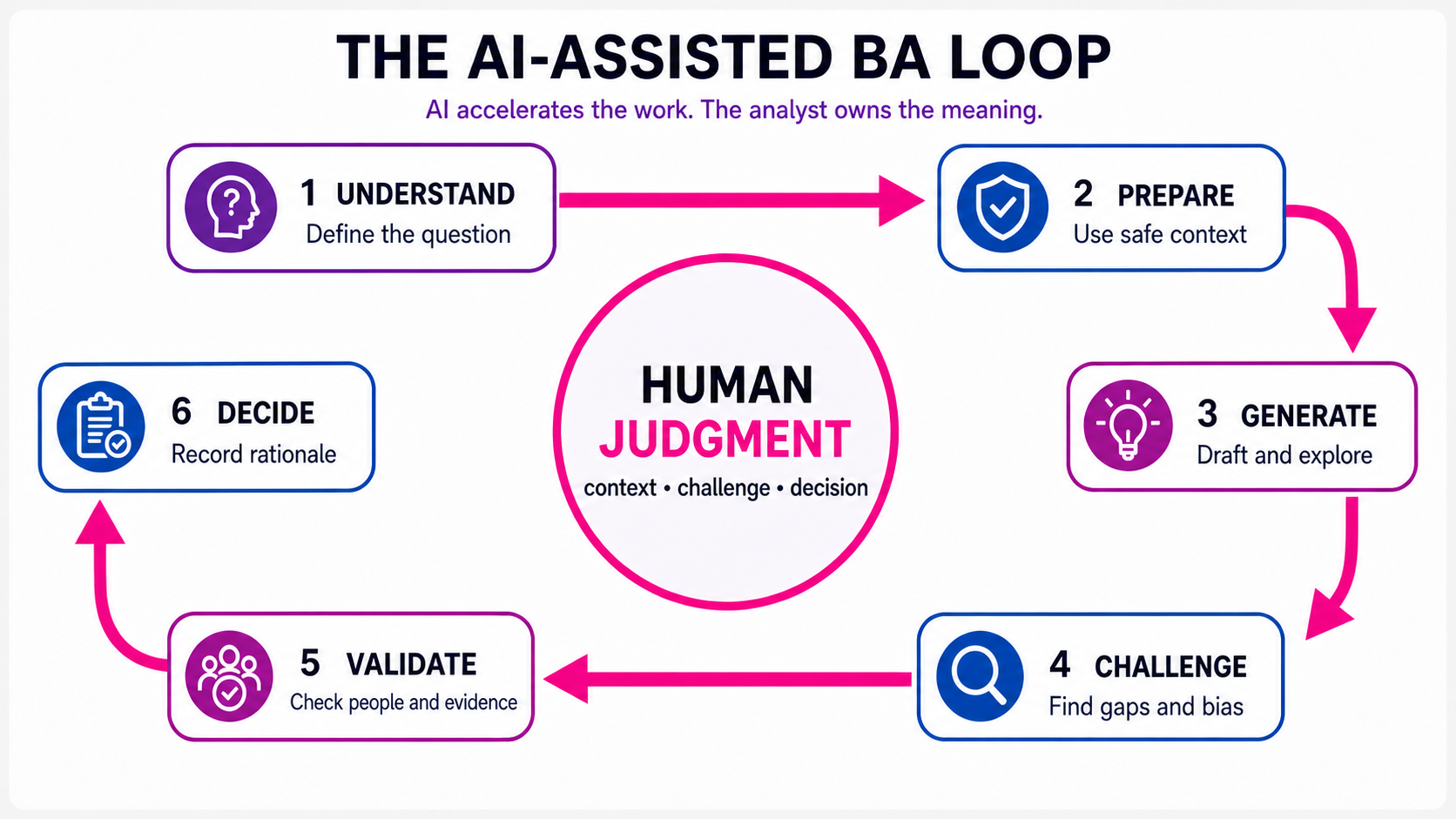
A practical loop for using AI without outsourcing accountability.
What AI is good at - and where it needs you
AI is brilliant at producing a useful first pass. It can compare, cluster, reformat, question and draft at a speed no human should feel obliged to match. The trap is confusing speed with certainty. Fluent output can still be wrong, incomplete or beautifully detached from the reality of your organisation.
| BA activity | Let AI help with | The human must own | Watch out for |
|---|---|---|---|
| Interview notes | Grouping themes; drafting a summary | Meaning, emotion, context and consent | Missing nuance; invented certainty |
| Requirements | Drafting stories, criteria and questions | Value, priority, feasibility and agreement | Generic requirements; hidden assumptions |
| Process analysis | Spotting patterns, gaps and variants | The real workflow and its exceptions | A neat process that nobody actually follows |
| Options | Generating alternatives and comparison criteria | Trade-offs, constraints and recommendation | Plausible options with no evidence |
| Communications | Adapting tone, length and structure | Accuracy, audience impact and final sign-off | Confidential data; bland or misleading copy |
The six-step AI-assisted analysis loop
You do not need a grand AI transformation programme to start. You need a small, repeatable discipline. Here is the loop I would use on almost any low-risk analysis task.
- Understand the job - State the decision or outcome before opening the tool. If you cannot explain what better looks like, AI will simply help you become unclear faster.
- Prepare safe context - Remove personal, commercially sensitive or otherwise restricted information. Use only tools approved by your organisation and give the model the minimum context it needs.
- Generate - Ask for a first pass, several options, a structured comparison or questions you may have missed. Treat the output as working material, not evidence.
- Challenge - Ask what assumptions were made, what contradicts the draft, who may be excluded and what would cause the recommendation to fail.
- Validate - Check claims against source material. Take interpretations and decisions back to the people who supplied the context. AI can suggest; stakeholders confirm.
- Decide and record - Make the judgement, capture the rationale and note where AI materially contributed. Traceability matters most when the answer looked obvious.
| Step | What good looks like | Evidence to keep |
|---|---|---|
| Understand | A specific outcome, decision or question | Problem statement; success measure |
| Prepare | Approved tool; minimum necessary information | Data classification; redaction note |
| Generate | More than one useful angle or draft | Prompt and relevant source material |
| Challenge | Assumptions and weak points are visible | Challenge questions; rejected options |
| Validate | Claims and interpretations are checked | Source links; stakeholder confirmation |
| Decide | A named person owns the final judgement | Decision, rationale and follow-up action |
A decent prompt is a miniature brief
Prompt engineering can sound like a mysterious new profession. For a BA, it is much less dramatic. A useful prompt is simply a clear brief: the job, the context, the boundaries and the shape of the output. In other words, the skills are already in the room.
| Prompt ingredient | What to include | BA example |
|---|---|---|
| Task | The specific job to be done | Cluster these observations into themes |
| Context | Audience, process and relevant background | This is discovery for a citizen-facing service |
| Evidence | The material it may use | Use only the redacted notes below |
| Constraints | What it must not infer or expose | Do not invent causes or name individuals |
| Output | The format that helps you act | Return a three-column table: theme, evidence, question |
| Challenge | How to test the first answer | List contradictions and missing perspectives |
Try this on a real piece of work
Act as an analysis assistant. Using only the redacted workshop notes below, group observations into themes. For each theme, show the supporting evidence, any contradictions and the questions a Business Analyst should take back to stakeholders. Do not infer intent or invent facts. Finish with a separate list of assumptions that require validation.
The strongest part of that prompt is not “act as an analysis assistant”. It is the instruction to use only the supplied evidence, expose contradictions and finish with assumptions that still need a human conversation.
Five traps that catch smart people
1. Pasting first, thinking later
The fastest route to a privacy problem is treating a public AI tool like a private notebook. Stop before you paste. Check the organisation’s policy, the information classification and whether the people represented in the material would reasonably expect it to be used this way.
2. Accepting polished output as evidence
AI is designed to produce a helpful-looking response. Helpful-looking and true are not synonyms. If the answer contains a claim, number, quote, legal position or technical constraint, verify it at the source.
3. Automating the ambiguity
A weak problem statement does not become stronger because a model processed it. Sometimes the correct move is not another prompt. It is another conversation.
4. Losing the minority view
Summaries reward common patterns. Business Analysis often depends on the exception: the accessibility need, the edge case, the frontline workaround or the quiet objection. Ask deliberately what the summary may have flattened.
5. Letting nobody own the answer
When an AI-assisted recommendation is wrong, “the tool said so” is not governance. Name the person accountable for the judgement, the people consulted and the evidence used.
Your first 30-minute experiment
Start with something useful, reversible and low risk. Do not begin with a hiring decision, a performance issue, sensitive customer information or anything else where a confident error could hurt someone.
- Choose a non-sensitive set of notes or an old artefact you know well.
- Give AI one clear task: summarise, compare, challenge or reformat.
- Run the output against your own analysis and mark what was useful, wrong or missing.
- Change the prompt once, based on the gap you found.
- Write down the rule you would reuse next time.
That final step is how experimentation becomes a practice. You are not just learning how a tool behaves. You are building a safer and more repeatable way of working.
Final thought: keep the uncomfortable bit
The uncomfortable bit of Business Analysis is rarely the document. It is the moment when two stakeholders mean different things by the same word. It is the hidden dependency, the awkward question, the user who was not invited, the trade-off nobody wants to own.
AI can help us reach those moments faster. Good. Let it take some of the admin. Let it give you a rough first pass. Let it challenge a draft and offer a perspective you might not have considered.
But keep the thinking.
Keep the curiosity, the context, the challenge and the accountability. Those are not the slow parts of the job. They are the job.
Use AI to create more space for human judgement - not to remove the need for it.