A thought‑leadership article for thebaproject.ie based on the BA ExOpp Model
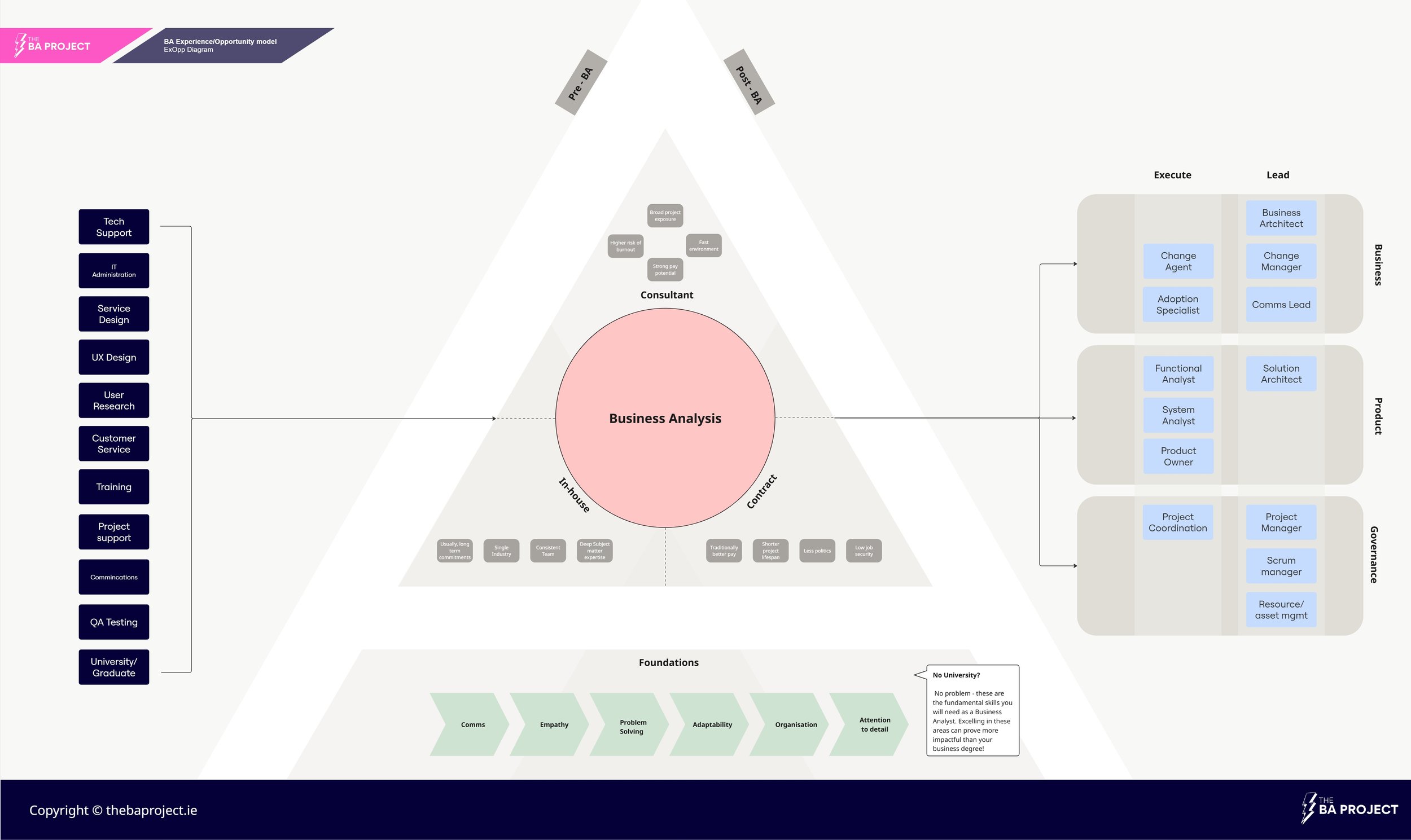
To download a pdf version of the ExOpp model, click here.
Most people don’t plan to become Business Analysts. They arrive at the role from every imaginable direction — customer service, product support, IT administration, university, or sometimes no formal education at all. And that’s the beauty of Business Analysis: it is one of the few professional disciplines where your mindset matters more than your academic background, your certifications, or the path you took to get here.
At The BA Project, we have met countless analysts across many industries. When we mapped their career stories, a clear pattern emerged — a pattern captured visually in our BA Experience & Opportunity (ExOpp) Model. This model shows what many of us have felt instinctively:
Business Analysis is not a job you fall into by accident.
It’s a gateway role.
It can be a launchpad into dozens of high‑value, high‑impact careers that shape organisations, products, services, and transformation programmes as well as a role that can set you up for a deeper dive in to the world of Business Transformation as a Business Architect.
This article breaks down the ExOpp Model and explains why the BA role is one of the most strategically valuable — and versatile — roles in the modern workforce.
No two Business Analysts share the same origin story. Some start in customer service and discover they have a knack for understanding people. Others come from product support, IT admin, or graduate programmes where curiosity outweighed experience. Some didn’t follow traditional education paths at all — and yet they thrive.
What ties these diverse backgrounds together is not a certification or a degree.
It’s the fundamentals:
Foundational Skill
| Core Skill | Why It Matters |
|---|---|
| Communication | Creates shared understanding |
| Empathy | Helps you read people and context |
| Problem‑solving | Turns ambiguity into clarity |
| Adaptability | Thrives in change |
| Organisation | Anchors projects |
| Attention to detail | Catches what others miss |
There Are Many Roads Into Business Analysis — and All of Them Are Valid
These skills show up in countless roles long before people ever call themselves “Business Analysts”. The ExOpp Model simply highlights what many already know: you might have been a BA long before your job title said so.
One of the most empowering insights from the ExOpp Model is this:
You don’t need a business degree.
You don’t need a certification.
You need the fundamentals.
The diagram places early‑career and pre‑BA backgrounds on the left/Input side:
University graduates
Career‑switchers without degrees
Product support teams
IT administrators
Customer service professionals
Each of these backgrounds brings something powerful, such as empathy, domain understanding, problem‑solving instincts, stakeholder communication, and adaptability — the very foundations of a strong BA.
The fundamentals listed in the model — communication, empathy, problem-solving, adaptability, organisation, and attention to detail — aren’t “nice to haves”. They are Business Analysis.
You can teach documentation standards.
You can learn modelling techniques.
You can upskill in Agile or Lean.
But the fundamentals? Those are what make a BA good.
Business Analysis as a Profession: The Centre of the Transformation Universe?
If the BA profession had a physical form, it would sit at the centre of every modern initiative. The ExOpp Model places Business Analysis directly in the middle for a reason: it's the role that touches the most disciplines, teams, and conversations. In the visual centre of the ExOpp Model sits Business Analysis, surrounded by execution‑level disciplines such as:
Project coordination
QA testing
Comms support
User research
Training
Functional analysis
System analysis
Some of this overlap is intentional; some is inevitable. But all of it creates a unique career multiplier. Few roles expose you to business, process, technology, people, and strategy all at once. Even fewer roles allow you to influence each of those areas without requiring deep technical expertise.
This is why the BA role is such a powerful centre point: from here, almost every direction becomes possible.
This is the reality of the BA role:
BAs sit at the intersection of business, people, process, technology, and change.
That intersection gives analysts exposure no other early‑career role provides. They see:
How decisions are made
How products are shaped
How organisations adapt
How technology is implemented
How teams collaborate under pressure
That is why the BA role is such a powerful foundation — it exposes you to a broad ecosystem very early, and that exposure compounds.
The BA Role as a Career Gateway — Four Major Pathways
The right side of the ExOpp Model maps the incredible breadth of opportunity that unlocks after becoming a Business Analyst. Each pathway offers its own rhythm, rewards, and challenges. It shows what happens after you gain BA experience. And this is where the model really shines: it demonstrates the branching career paths available.
A. Business-Focused Path: Deepening the Business Lens
If you love operating models, organisational behaviour, or the mechanics of how a business runs, this path is a natural extension.
Typical roles include:
Business Architect
Business Service Designer
Change Agent
These roles allow you to influence strategy without becoming a traditional strategist, and shape services without becoming a traditional designer.
B. Product & Functional Path: Shaping What Gets Built
Some BAs gravitate toward product thinking — the “why” behind features, the trade-offs, the customer impact.
Here, the path often looks like this:
| Role | Focus |
|---|
| Product Owner | Value delivery, prioritisation, user outcomes |
| Functional Analyst | Translating business needs into functional design |
| UX Design | Understanding user behaviours through research and design |
These roles put you closer to the user, the vision, and the solution itself.
C. Project, Delivery & Governance Path (Driving the Work Forward)
Many analysts realise their strength lies in bringing order to chaos. Not every BA wants to move into product or business design. Some discover they are unusually good at orchestrating work.
This path includes:
Scrum Master
Project Manager
Governance & resource management roles
Change Manager
These positions offer structure, pace, and the satisfaction of steering a project to successful delivery.
D. Leadership Path: Turning Insight Into Influence
The BA role naturally cultivates leadership behaviours — analytical clarity, confident communication, stakeholder influence, and cross-team visibility. That’s why so many senior leaders come from BA roots.
Leadership is not a separate track — it’s the convergence of the BA skillset applied at scale.
Business Analysts often underestimate just how naturally their work prepares them for leadership. Long before someone is given a formal title — “Lead”, “Manager”, “Head of…”, “Director” — they’ve already been doing the work of a leader simply through the nature of the BA role. BAs sit at the intersection of people, process, product, technology, and decision‑making. That vantage point accelerates maturity in ways many early‑career roles simply can’t. Over time, analysts build a toolkit that mirrors what organisations expect from their senior leaders:
Critical thinking
BAs learn to see beyond symptoms and into root causes. They question assumptions, unpack complexity, and anticipate second‑order effects — the same cognitive discipline used by strategic leaders making high‑stakes decisions
Communication excellence
Whether it’s translating technical detail into plain English, facilitating workshops, or aligning competing viewpoints, BAs sharpen communication skills faster than most other roles. Leaders win through clarity, and BAs practice clarity daily.
Stakeholder influence
Analysts navigate politics, personalities, and priorities — often without authority. They learn to influence decisions based on logic, empathy, and evidence. That “influence without power” muscle is one of the strongest predictors of leadership potential.
Problem‑solving under pressure
When timelines are tight, ambiguity is high, or solutions carry risk, BAs remain steady. They break down complexity and give teams a path forward — a behaviour indistinguishable from effective leadership.
A whole‑business perspective
Few roles offer such a panoramic view. BAs see operations, strategy, customer needs, technology constraints, governance structures, and delivery pressures. Leaders need this breadth — BAs cultivate it naturally.
Because of this blend of strategic insight, communication strength, and operational awareness, organisations often look to former BAs when filling senior roles that require both vision and execution capability.
This is why analysts so frequently progress into positions such as:
Head of Business Analysis
Head of Product
Transformation Lead
Programme Manager
Director of Change
Enterprise Architect
These roles demand the ability to diagnose problems, connect dots across functions, lead multidisciplinary teams, and bring clarity to complex environments — all core BA strengths.
In many ways, the BA role is one of the few early‑career positions that builds the foundation for leadership from day one. Analysts don’t just observe how organisations work; they help shape how organisations think, adapt, and make decisions. That combination of insight, communication, systems awareness, and human understanding is why so many BAs find themselves moving into leadership roles earlier — and more confidently — than they ever expected.
Ultimately, the BA profession doesn’t just prepare people to do analysis.
It prepares them to lead with insight, empathy, and strategic clarity — the defining characteristics of modern organisational leadership.
The Trade‑offs of Each Path — And How the BA Role Prepares You
One of the most valuable things about the BA Experience & Opportunity Model is that it doesn’t pretend every career path is perfect. Instead, it acknowledges reality: every direction you can take has trade‑offs. Some people thrive in fast‑paced environments; others prefer deep expertise; others want structured delivery. None of these are “better” than the others — they’re simply different.
What matters is understanding yourself enough to choose the environment that aligns with your strengths, your energy, and your long‑term goals. And more importantly: recognising that the fundamentals you build as a BA equip you to succeed in any of them
Consultancy & Product: Pace, Pressure, and Possibility
Roles in consultancy or product organisations tend to move quickly. You’re exposed to a wide variety of clients, domains, or features, and you can find yourself solving different kinds of problems almost weekly. That variety accelerates learning and often comes with higher earning potential.
But the pace can be intense. Deadlines compress, context switches frequently, and burnout is a real, documented risk. These environments reward clarity, adaptability, and rapid problem‑solving — all traits sharpened through Business Analysis.
The reason many BAs succeed here is simple:
they’re already wired to make sense of ambiguity, to speak to different audiences, and to absorb new contexts quickly.
In‑House Roles: Depth Over Speed
In‑house roles offer something completely different: depth. You get to understand an organisation at its core — its systems, culture, customers, pain points, politics, and long‑term strategy. This creates space to build deep subject‑matter expertise and often clearer, more predictable career ladders.
The trade‑off is reduced variety. While consultancy exposes you to dozens of contexts, in‑house work immerses you deeply in one. For many, that stability, continuity, and long-term ownership is exactly what they want.
BAs thrive here because they naturally become the “go‑to” people — the individuals who understand how things truly work, who connect teams, and who can be trusted with bigger responsibilities over time.
Delivery & Project Governance: Structure and Accountability
For those who prefer predictable frameworks, delivery roles offer clarity. Project cycles are shorter; responsibilities are well defined; processes are structured. There is often a clearer sense of “start, middle, finish” — which appeals to people who enjoy momentum and closure.
However, some delivery environments (especially contract‑heavy ones) bring less job security. And while structured, these roles still demand exceptional communication and decision‑making under pressure.
BAs excel here because they’re already comfortable bridging gaps, clarifying scope, identifying risks, and guiding teams toward alignment — the very behaviours project leaders depend on.
Why the Path Matters Less Than the Preparation
The most important insight isn’t that each pathway has advantages and limitations — it’s that none of them are out of reach for someone with strong BA fundamentals.
A BA with excellent communication can flourish in consultancy.
A BA with a love for depth can thrive in in‑house roles.
A BA who enjoys clarity and movement can excel in delivery governance.
Because Business Analysis develops some of the most transferable skills in the modern workforce — structured thinking, stakeholder influence, problem‑solving, customer awareness, and adaptability — BAs have the freedom to choose the environment that fits them best.
In a world where careers no longer follow a straight line, the BA role is uniquely future‑proof. It prepares you to move sideways, upwards, or across disciplines, all without starting over. And that flexibility is its greatest strategic advantage.
The Most Important Message:
You Don’t Need Permission to Start — And You Don’t Need Certification to Be Great
Here’s the biggest misconception in the industry:
“You can’t be a BA without formal accreditation.”
The reality?
Some of the strongest analysts have never held a certification. What they did have was curiosity, clarity, empathy, and the ability to make complex things simple.
Certifications are helpful.
They’re not foundational.
The fundamentals — the ones at the centre of the ExOpp Model — are what make you employable, promotable, and versatile. Everything else is training.
Business Analysis Is Not an End State — It’s a Launchpad
One of the most important ideas behind the ExOpp Model is that it refuses the traditional, outdated notion of career “ladders.” Ladders imply upward motion only. One direction. One definition of success. One narrow path where each step depends on the one before it.
But Business Analysis doesn’t work that way — and neither do modern careers.
The ExOpp Model is intentionally designed as a map, not a hierarchy. It recognises that once you move into the BA role, you aren’t stepping onto a single track — you’re stepping into an ecosystem. A landscape of possibilities. A set of branching routes that reflect your strengths, your interests, your pace, and the type of impact you want to make.
From that point forward, your career becomes less about climbing and more about navigating.
What Opens Up Once You Step Into the BA Role
When someone becomes a Business Analyst, their world expands quickly, because the role sits at the intersection of almost everything an organisation cares about: people, process, systems, customer value, technology, governance, service delivery, and change.
That intersection creates a kind of professional compound effect:
Exposure across the business
You see the organisation end‑to‑end — not just a slice of it. You meet teams you never knew existed, understand their pressures, and learn how work flows between them.
Cross‑functional visibility
You’re rarely tied to one group. Instead, you’re the connective tissue between departments, priorities, and personalities. This visibility makes you recognisable and, often, relied upon.
Transferable skills
The work you do — problem‑solving, facilitation, communication, prioritisation, systems thinking — travels well. It is currency across industries, sectors, and roles.
Understanding of how decisions are made
While many roles only see the outcome, BAs witness the machinery of decision-making: the constraints, politics, data, risks, and trade‑offs behind every major choice.
Insight into how organisations evolve
You see what triggers change, how people respond to it, and what needs to be in place for a transformation to succeed. That’s rare insight — and an early preview of leadership.
Together, these experiences form a foundation that very few entry‑level or early‑stage roles can provide. Most people spend years trying to piece together what a BA learns in their first one or two projects.
BA Isn’t the Destination — It’s the Doorway
Another great misconception about Business Analysis is that it’s a fixed career identity. Something you stay as, rather than something you launch from.
But the reality, shown clearly in the ExOpp Model, is that the BA role is one of the most versatile, portable, and future‑proof starting points in the modern workplace.
Once you’re in the BA world, the question stops being “What can I do next?” and becomes “Which direction do I want to explore?”
Do you want to go deeper into product? You can.
Do you want to lead delivery? Absolutely.
Do you want to design services or shape strategy? Yes, that’s a path too.
Do you want to evolve into architecture, change, or transformation? Completely viable.
The BA role gives you access.
It gives you context.
It gives you options.
Most importantly, it gives you the confidence and capability to walk through whichever door speaks to you — and the freedom to change direction later without starting from scratch.
Business Analysis isn’t where your career settles. It’s where your career becomes possible.